Nickel-Hydrogen Batteries
EnerVenue: "Today's most widely deployed battery solution, lithium-ion, was not built for the long-term requirements energy infrastructure poses. The clearest indication: Large scale energy infrastructure developers are actively searching for new solutions to replace lithium-ion ESS..
In the 1980s, NASA deployed nickel-hydrogen battery technology for missions where failure was not an option and replacement was nearly impossible. That chemistry powered the Hubble Space Telescope and the International Space Station for decades, accumulating more continuous operational hours than any other battery chemistry ever built.
Stanford University's Prof. Yi Cui—one of the world's preeminent material scientists—recognized that the same proven chemistry could be refined for grid-scale deployment at a fraction of its original cost. That research became EnerVenue..
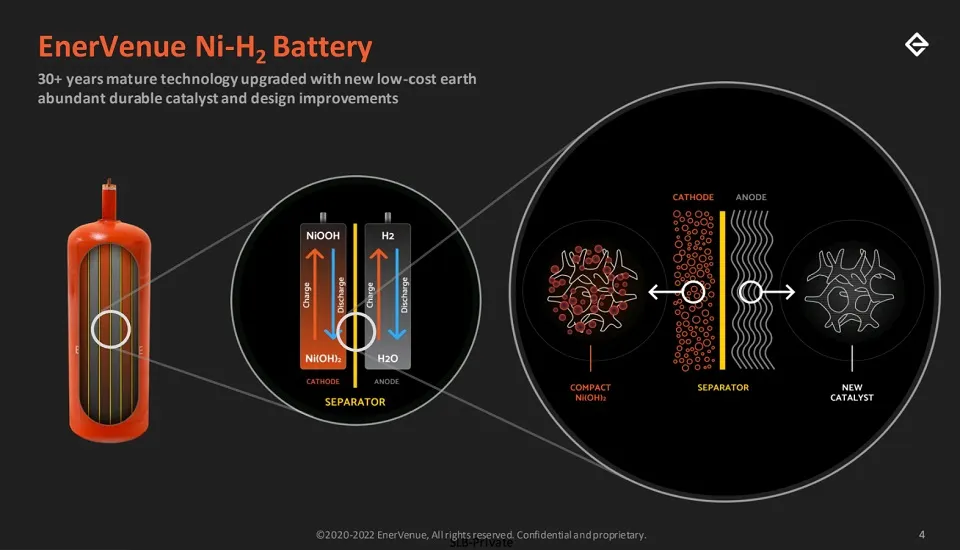
The Aqueous Metal Cell contains a nickel hydroxide cathode and a nickel alloy anode in an alkaline electrolyte. On charge, hydrogen gas is produced and stored inside a sealed, large format cell. On discharge, hydrogen reaction is reversed. The system is hermetically sealed. No liquid spillage. No venting. No thermal cascade pathway.
"[W]hen AGL Energy went looking for a battery chemistry that.. had some attractive characteristics, it chose nickel-hydrogen. That’s a chemistry that until a few years ago been used almost exclusively in space.. AGL aims to build 12 gigawatts of new renewable energy and storage over the coming decade...
Nickel-hydrogen batteries can cycle 30,000 times and up to three times a day, with very low 'degradation' – the gradual reduction in energy storage capacity. Lithium-ion batteries can cycle about 10,000 times and degrade more quickly."